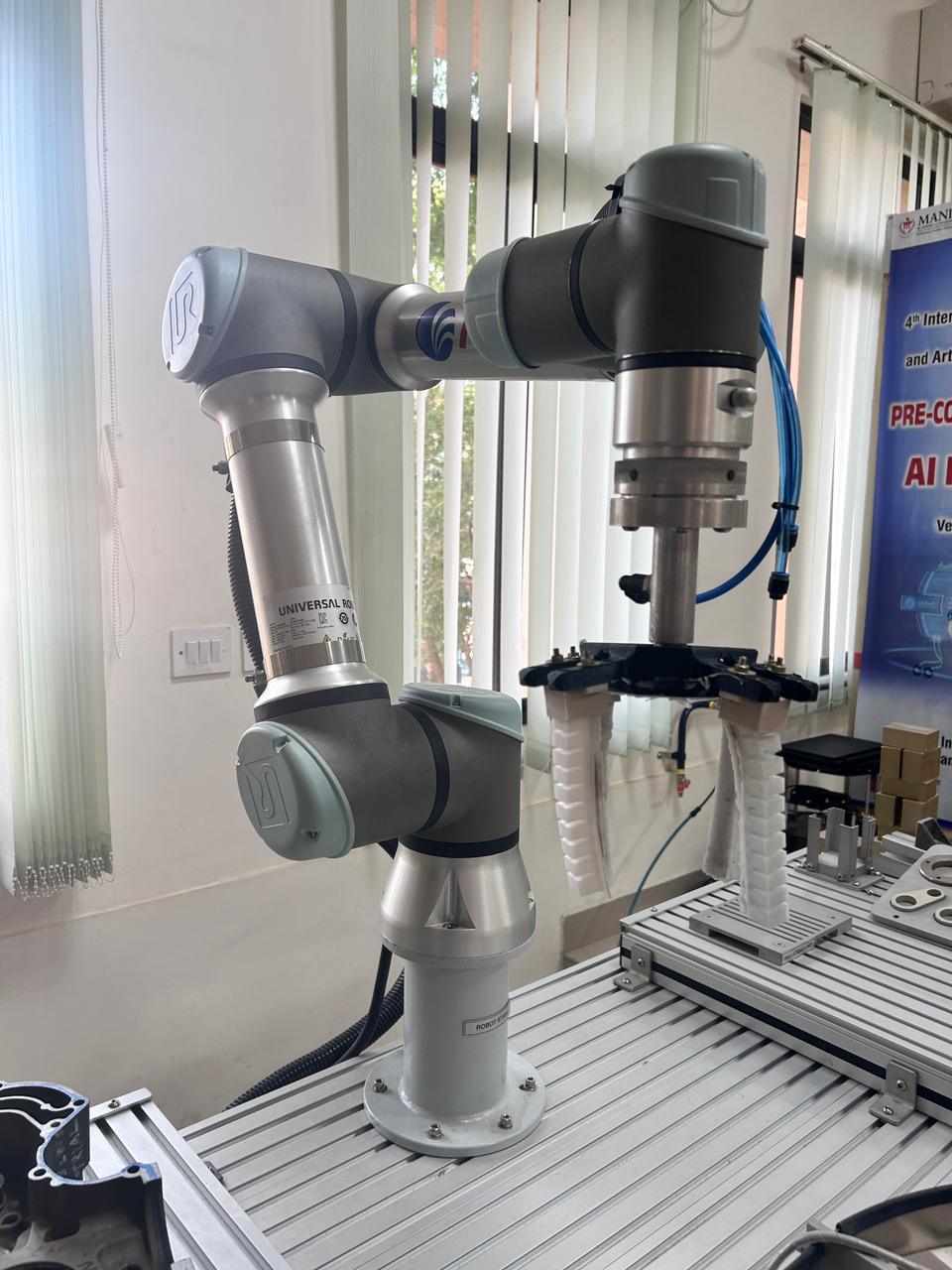
Why Soft Robotics Fascinated Me
There's something deeply satisfying about watching a compliant robotic gripper wrap around an object—something that rigid metal fingers could never achieve. While traditional industrial grippers rely on precise mechanical tolerances and complex sensing systems, soft robotics takes a fundamentally different approach: embrace compliance, not rigidity.
I came across soft robotics during my exploration of bio-inspired design, and the field immediately captured my attention. The idea that you could create a gripper from silicone rubber that naturally conforms to object shapes without requiring complex control systems felt almost magical. It's robotics that borrows from biology—flexible, adaptive, and inherently safe.
This project became my deep dive into that world: designing, fabricating, and testing a pneumatically-actuated soft robotic gripper that could manipulate delicate and irregularly-shaped objects while integrated with a cobot collaborative robot arm.
The Problem with Rigid Grippers
Traditional rigid grippers dominate industrial automation, but they come with significant limitations:
- Fragile Object Handling: Metal fingers can easily crush delicate items
- Complex Sensing Requirements: You need force sensors, tactile arrays, and sophisticated control algorithms just to avoid breaking things
- Limited Shape Adaptability: Each object geometry requires custom gripper designs or complex reconfiguration
- Safety Concerns: Rigid actuators pose collision risks in human-collaborative environments
I witnessed these problems firsthand in manufacturing labs—expensive grippers that could handle one type of object brilliantly, but failed completely when presented with something even slightly different. For applications like food handling, pharmaceutical packaging, or electronics assembly, this inflexibility becomes a major bottleneck.
The soft robotics approach offers an elegant solution: let the material do the work. A compliant gripper naturally wraps around objects, distributes contact forces safely, and can handle diverse shapes without reprogramming.
What I Set Out to Build
The goal was ambitious but clear: design and fabricate a fully functional soft robotic gripper that could:
- Pneumatically actuate using simple pressure control (5-50 kPa range)
- Integrate seamlessly with a Universal Robots cobot collaborative arm
- Manipulate diverse objects from small bottles to irregular fabric bags
- Achieve large deformations while maintaining structural safety
- Demonstrate real-world applicability through comprehensive experimental testing
The design needed to balance several competing requirements:
- Soft enough for compliance, but structural enough for load-bearing
- Large deformation range without material failure
- Custom palm geometry optimized for the cobot mounting interface
- Reliable pneumatic channels that wouldn't leak or collapse
- Fabrication feasibility using accessible molding techniques
Design Philosophy & Geometry
The gripper design philosophy centered on compliant deformation through pneumatic actuation. Rather than using motors and gears, the gripper would bend and wrap using pressurized air chambers embedded within the silicone structure.
Finger Architecture
Each finger incorporates:
- Internal Pneumatic Channels: Hollow chambers that expand when pressurized
- Curved Profile Geometry: Optimized for natural wrapping motion around cylindrical and spherical objects
- Variable Thickness Distribution: Thin outer walls for flexibility, thicker base sections for structural support
- Dual-Section Construction: Base and top segments that work together to create controlled bending
The finger geometry was carefully tuned in CAD (SolidWorks) through iterative design. The key insight was that bending doesn't happen uniformly—it's concentrated at specific hinge regions where the wall thickness transitions. By controlling these transition zones, I could direct exactly how the finger would curl.
Custom Palm Design
The palm represents a major innovation in this gripper. Rather than using a standard off-the-shelf mounting plate, I designed a custom palm structure specifically optimized for two critical functions:
- Cobot Integration: The mounting interface matches the cobot end-effector geometry, ensuring secure attachment and proper load distribution
- Pneumatic Distribution: Internal channels route air from a single input port to all finger actuators simultaneously
The palm provides the rigid structural foundation that the flexible fingers attach to. It's the critical interface between the soft gripper body and the rigid robotic arm—a hybrid design that leverages the strengths of both paradigms.
Most importantly, the palm was designed with enhanced contact geometry to improve object manipulation when items rest against the palm surface during grasping. This custom geometry increases the effective grip area beyond what the fingers alone could achieve.
Material Selection & Fabrication Process
Why Ecoflex 10?
After evaluating several silicone elastomers, I selected Ecoflex 10 (Smooth-On Inc.) for several critical reasons:
- Exceptional Elongation: >900% strain at break—essential for large deformations
- Ultra-Soft Shore Hardness: 00-10 rating provides the compliance needed for delicate object handling
- Excellent Tear Resistance: Withstands repeated actuation cycles without degradation
- Biocompatibility: Safe for food handling applications if needed
- Casting-Friendly: Low viscosity (12,000 cps) flows into complex mold geometries easily
The material specifications checked all the boxes for soft robotic applications.
The Fabrication Journey
Fabrication turned out to be far more challenging than I anticipated. What looked simple in theory—"just cast silicone into a mold"—revealed itself to be a delicate process requiring extreme attention to detail.
Mold Preparation
The process started with 3D-printed molds (PLA) produced from the SolidWorks CAD models:
- Surface Finishing: Extensive sanding and post-processing to achieve smooth mold surfaces
- Mold Release Application: Critical for clean demolding without tearing the cast parts
- Precise Alignment: Careful registration of multi-part molds to ensure proper cavity formation
Mixing & Degassing
Ecoflex 10 uses a 1A:1B mix ratio by volume. This step is deceptively critical:
- Thorough Mixing: Incomplete mixing leads to uncured regions and material inconsistencies
- Degassing in Vacuum: Essential to remove air bubbles that would create defects
- Extended Vacuum Time: Minimum 10-15 minutes; rushing this step ruins the casting
Casting & Curing
Pouring the degassed material into the assembled molds required steady hands and patience:
- Complete Cavity Filling: Ensuring all internal pneumatic channels form properly
- Room Temperature Cure: 4 hours minimum, with post-cure optional
- Careful Demolding: Avoiding tears to the thin-walled structures
Post-Processing
After demolding:
- Flash Removal: Trimming excess material at mold seams
- Assembly: Attaching fingers to the palm structure
- Pneumatic Connections: Integrating tubing and fittings for air supply
- Cobot Mounting: Final integration with the robot arm
Actuation & Control Strategy
The control strategy is elegantly simple—one of the advantages of soft robotics.
Pneumatic Actuation Mechanism
When air pressure is applied to the internal chambers:
- Chamber Expansion: The thin outer walls stretch as the chamber inflates
- Domino Bending: Adjacent chamber walls push against each other sequentially
- Curved Motion: The finger bends inward, wrapping around objects
- Conformal Grasping: The compliant material distributes contact forces evenly
The beauty of this system is that no feedback control is required for basic grasping. Apply pressure, the finger bends. Remove pressure, the material's elasticity returns the finger to its resting state.
Pressure Operating Range
Through finite element analysis and experimental testing, I established the operational envelope:
- 5-20 kPa: Light grasping for delicate objects (soft fruits, electronics)
- 20-40 kPa: Normal operation range for most manipulation tasks
- 40-50 kPa: Maximum safe pressure for heavy objects (up to 90g successfully tested)
- >53 kPa: Structural instability begins (avoided in practice)
The cobot's programmable I/O can control a pressure regulator to achieve these levels, enabling task-specific grasping strategies.
Experimental Setup & Testing
Testing was comprehensive, spanning three major experimental campaigns:
1. Deformation Validation
Objective: Validate the ANSYS FEA predictions against real-world behavior
Method:
- Attached flex sensors to finger outer surface
- Measured deformation at 6 pressure levels (0, 5, 10, 20, 30, 40 kPa)
- Compared experimental values to FEA-predicted deformations
Key Insight: The FEA model proved highly accurate, with only 5-6% error at most pressures. This validated the entire design process and gave confidence in the simulation predictions.
2. Grip Force Measurement
Objective: Quantify the actual forces the gripper can apply to objects
Method:
- Load cell integrated into experimental setup
- Measured grip forces at 5 pressure levels (10-50 kPa)
- Tested with two object types (cylindrical bottles)
Results:
- Force range: 0.063 N (10 kPa) to 0.312 N (50 kPa)
- Nonlinear pressure-force relationship (expected for hyperelastic materials)
- Sufficient force for objects up to approximately 32g theoretical capacity
3. Object Manipulation Testing
Objective: Demonstrate real-world manipulation capability across diverse objects
Method:
- Selected 6 diverse test objects: balls, bottles, boxes, fabric bags
- Weight range: 11-90g (8.2-fold variation)
- Shape diversity: spherical, cylindrical, rectangular, irregular
- Success criteria: Stable lift and hold for 5+ seconds
Results: Reliable actuation performance during testing across all 6 objects
Key performance insights:
- Small diameter objects (<6cm) were most challenging but still manageable
- Textured surfaces were easiest to grasp (enhanced friction)
- Large objects (15cm cardboard box, 90g) required palm contact for stability
- Irregular shapes (fabric bag) actually enhanced grip through multiple contact points
The gripper successfully manipulated objects nearly 3× heavier than the theoretical force capacity suggested—evidence that compliant grasping distributes loads effectively.
Grasping Performance & Results
The ANSYS finite element analysis provided critical insights before any physical fabrication:
Deformation Performance
At the recommended 40 kPa operating pressure:
- Maximum Deformation: 151.07 mm (achieved in 0.8 seconds)
- Deformation Efficiency: 3.78 mm/kPa
- Wrap-Around Capability: Sufficient for objects from 5cm to 17cm diameter
This deformation range proved adequate for the entire spectrum of test objects.
Strain & Stress Analysis
The FEA revealed:
- Maximum Equivalent Strain: 42.54% (well within the 900% material limit)
- Material Safety Factor: 21.2× (extremely conservative)
- Maximum Von-Mises Stress: 0.313 MPa (far below tensile strength)
- Operational Safety Factor: 1.33× (13 kPa margin to instability)
These numbers confirmed that the gripper operates with massive safety margins. No material failure risk under any normal operating condition.
Pressure-Deformation Relationship
The analysis across 5-50 kPa revealed:
- Nonlinear Response: Deformation increases super-linearly with pressure (hyperelastic behavior)
- Stable Convergence: No numerical instability below 53 kPa
- Rapid Response: Peak deformation reached within 1 second
What Failed (And What Taught Me the Most)
Fabrication wasn't smooth. I encountered three major failure modes that taught me more than the successes:
Failure 1: Air Bubbles & Holes
Problem: Initial castings emerged riddled with air bubbles, creating holes in the finger walls and compromising pneumatic channel integrity.
Root Cause:
- Inadequate degassing time (I was impatient)
- Air introduction during mixing (too vigorous stirring)
Solution:
- Extended vacuum degassing to minimum 15 minutes
- Gentle folding technique during mixing instead of vigorous stirring
- Visual inspection of mixed material before pouring
Lesson: Patience is not optional in soft robotics fabrication. Rushing the degassing step ruins everything.
Failure 2: Air Leaks from Misalignment
Problem: When I finally got bubble-free castings, some grippers had air leaks at the seams where mold parts joined.
Root Cause:
- Improper mold alignment during assembly
- Gaps between mold components allowed silicone to flow into unintended regions
Solution:
- Designed and incorporated alignment pins into mold revisions
- Careful assembly procedure with visual verification before pouring
- Proper mold release agent application to all surfaces
Lesson: Mold design is as critical as gripper design. Alignment features aren't optional—they're essential.
Failure 3: Blocked Pneumatic Channels
Problem: The most frustrating failure—grippers that looked perfect externally but wouldn't actuate at all. Cross-sectioning revealed completely blocked internal air chambers.
Root Cause:
- The mold's base section was designed too thick
- When cast, the base material filled the spaces intended for pneumatic channels
- Dimensional error in CAD → complete functional failure
Solution:
- Careful cross-sectional analysis of all mold designs before printing
- Verification of internal cavity spacing using CAD sectioning tools
- Test castings with transparent PLA molds (could see internal structure before committing to full fabrication)
Lesson: What you can't see will hurt you. Internal geometries require as much design verification as external surfaces.
These three failures taught me that soft robotics fabrication is a precision craft, not a forgiving process. Each defect traced back to a specific procedural mistake that could be systematically addressed.
Key Research Takeaways
After months of design, iteration, fabrication, and testing, several insights stand out:
1. Custom Palm Design Matters
The custom palm wasn't just about mounting—it significantly enhanced grip performance. When objects made contact with the palm surface during grasping, the increased contact area stabilized the grip. This was particularly evident with larger objects like the 15cm cardboard box.
2. Finite Element Analysis is Invaluable
The ANSYS FEA wasn't just theoretical—it accurately predicted real-world behavior with <6% error. This gave confidence to push the design to higher pressures and validated the hyperelastic material model (Yeoh 2nd order). For future projects, comprehensive FEA upfront saves enormous time in physical iterations.
3. Compliant Grasping Exceeds Force Predictions
The gripper manipulated objects nearly 3× heavier than the measured grip force would suggest. This isn't magic—it's the distributed contact mechanics of compliant materials. The soft fingers wrap around objects, creating friction over a large surface area rather than concentrated contact points. This is the core advantage of soft robotics.
4. Fabrication Quality Determines Performance
No amount of clever design can overcome poor fabrication. Air bubbles, misalignment, or blocked channels turn a theoretically perfect gripper into a non-functional chunk of silicone. Quality control at every fabrication stage is non-negotiable.
5. Soft Robotics Enables Industrial Integration
The cobot integration proved that soft grippers aren't just lab curiosities—they can seamlessly integrate with industrial robotic systems. The custom palm mounting interface ensured proper load distribution and eliminated the workspace conflicts that plague many soft gripper designs.
What I'd Improve in Version 2
This project was a success, but several areas could be enhanced:
1. Integrated Sensing
The current gripper relies on open-loop pressure control. Adding embedded sensors would enable:
- Force feedback: Real-time grip force measurement for adaptive control
- Tactile sensing: Contact detection and localization
- Proprioception: Finger curvature feedback for improved manipulation strategies
Flexible sensor integration (conductive polymer sensors, optical fibers) could be incorporated into future molds.
2. Individual Finger Control
Currently, all fingers actuate simultaneously from a single pressure source. Independent pressure control for each finger would enable:
- Asymmetric grasping: Better handling of irregular shapes
- Precision manipulation: In-hand object reorientation
- Adaptive strategies: Adjust individual finger pressures based on object properties
This requires a more complex pneumatic control system but unlocks significantly enhanced dexterity.
3. Alternative Materials Exploration
Ecoflex 10 performed well, but other materials could offer advantages:
- Stiffer elastomers (Ecoflex 30, Dragon Skin) for higher force capacity
- Multi-material casting (soft fingers, stiffer palm) for optimized performance
- Self-healing materials for improved durability
4. Long-Term Durability Testing
The current testing demonstrated successful manipulation across diverse objects, but long-term durability remains unexplored:
- Fatigue testing: 10,000+ actuation cycles to assess material degradation
- Wear characterization: Surface abrasion from repeated object contact
- Environmental testing: Performance under varying temperature and humidity
5. Expanded Object Testing
While the 6 test objects were diverse, even broader testing would better characterize capabilities:
- Fragile items: Eggs, tomatoes, glassware (safe handling validation)
- Extreme geometries: Very large (>20cm) or very small (<3cm) objects
- High mass: Objects >100g to establish true weight limits
Final Reflections
This project transformed my understanding of what's possible in robotics. Soft robotics isn't about replacing rigid systems—it's about solving problems where compliance, safety, and adaptability matter more than precision and speed.
The gripper successfully demonstrated that a relatively simple design—pneumatic actuation, compliant materials, thoughtful geometry—can achieve manipulation capabilities that would require enormous complexity in a rigid system. No force sensors, no complex control algorithms, no expensive actuators. Just air pressure and smart material choices.
The fabrication journey taught me that engineering reality is messy. Designs that look perfect in CAD can fail spectacularly in physical form. But each failure refined the process, and the systematic troubleshooting approach turned failures into insights.
Most importantly, this project proved that soft robotics is ready for real industrial applications. The cobot integration, diverse object manipulation, and robust performance demonstrate that these systems can move beyond research labs and into manufacturing facilities, warehouses, and human-collaborative workspaces.
If you're considering a soft robotics project: embrace the failures, trust the physics, and remember that patience in fabrication pays enormous dividends in performance.
Project Status: Completed November 2025
Institution: Manipal Institute of Technology, MAHE
Hardware: Universal Robots Cobot, Custom Pneumatic Gripper
Software: SolidWorks (CAD), ANSYS (FEA)
Materials: Ecoflex 10 Silicone, 3D-Printed PLA Molds